Showing posts with label photography. Show all posts

Friday, May 2, 2014

Human Like Me


While pet portraits seem to be everywhere we turn, they aren’t a recent phenomenon, in fact, one of the earliest animal portraits date back to 15,000 BC where bison and other animal paintings were carved in Lascaux caves in France.


In contemporary time, thanks to social media outlets like Facebook, Instagram, and Youtube, pet portraits circulate through society like lightening. Within a few seconds a proud pet parent can snap a picture of their beloved pooch with their mobile phone and upload it to several social media outlets for friends and family to enjoy. Sometimes those portraits or videos go viral and become a cult favorite like The Disapproving Rabbits, Colonel Meow (Colonel Meow recently passed away this past January, RIP), or I am sure everyone’s favorite, Talking Dog. In addition to pet portraits floating around the Internet, many have framed pictures at home and at work to celebrate their love for their pet. In fact, here’s the picture I have on my work desk.


So what makes us want to watch hours of cat videos or why do we have more pictures of Fido on our phone than of friends or our Mom? What makes us say “oh how cute!” when the neighbor shows us the latest picture of her bunny? What is the unspoken connection that we have with our pets that we can’t quite put our finger on?


Could it be anthropomorphism? Do we project human emotions onto our cherished pets? Do our pets really feel guilt, loneliness, or jealousy? Photographer Maija Astikainen is exploring this exact possibility through her portrait series, One-Dog Policy which started in 2010 and is an ongoing project. 

When you scroll through the portraits, ask yourself what emotions you see upon these pups’ faces. Do you see a Bulldog lamenting his upcoming bath? Do you see a depressed Greyhound on the sofa yearning for her pet parent to return home? Do you see a guilty dog peering from behind a white dining table; did he eat the baked chicken that was sitting there minutes ago?


Regardless if you see the same emotions as I did in these portraits or believe that's its only anthropomorphism, you cannot deny that there is a powerful bond between people and their pets, one that is almost magical and certainly timeless.

To see Maija Astikainen’s portrait series- click here and feel free to comment on your thoughts below.


Monday, December 2, 2013

Media, Power, Social Change, and the Feline Absent Referent

My colleague Cheryl Abbate who is a graduate student of philosophy and animal ethics at Marquette University in Wisconsin shared this bizarre news story with me (please click to watch the video).  PETA paid for a somewhat graphic image of a cat undergoing medical experimentation to be posted on buses to raise awareness about Nonhuman Animal testing at the University of Wisconsin, Madison.  In the clip, the news station frames the story as a question of obscene imagery and First Amendment rights.  The newscaster, the bus management, and the public are all presented questioning PETA's legal ability to post the imagery publicly.  Never once is the animal testing actually discussed.


Really, the image isn't even that graphic compared to the scads of absolutely horrific, keep-you-up-at-night, scar-you-for-life, secondary post traumatic stress disorder-inducing imagery that is out there (I just returned from a research trip to the Tom Regan Animal Rights Archive and I'm still trying to recover from the images I saw).  But why has the news story focused only on the First Amendment when the big elephant in the room (or suffering orange cat in this case) is staring us right in the face?

If the viewers relied solely on what the news story presented, they'd never even know there was a problem with the systematic torture and killing of cats in their community.  The university's violence against Nonhuman Animals is completely ignored.  Instead, attention is drawn to the  violence to those humans made uncomfortable by the image or those worried about harm to their business.  An attempt to raise awareness about the interests of the vulnerable has been manipulated as a story about the interests of the privileged.

Research has demonstrated that vegan rhetoric is often distorted by mainstream elite-controlled media to either defame and dismiss veganism, or twist animal-positive ideas to support the status quo.  The media is an agent of socialization created and maintained by those in power.  In this case, the multi-billion dollar science industry and the large university get the privilege to shape reality.  These entities not only hold tremendous sway over the community, but they have also infiltrated the institution of media itself.  As we know, the media is run by powerful white men and their corporate interests.

Indeed, many social movement scholars question the ability for social movements to successfully utilize the media to disseminate messages of radical social change and equality.  On the other hand, the power of morally shocking imagery was also demonstrated.  Many concerned citizens have been contacting the university with complaints.  Fortunately, the news team and others working to maintain the existing power structure can't follow the buses around and try to deflect everyone's attention from Nonhuman Animal rights to First Amendment rights.

References

Cole, M. and K. Morgan.  2011.  "Veganphobia:  Derogatory Discourses of Veganism and the Reproduction of Speciesism in UK National Newspapers."  The British Journal of Sociology 62 (1):  134-153.

Freeman, C.  2009.  "This Little Piggy Went to Press;  The American News Media's Construction of Animals in Agriculture."  The Communication Review 12 (1):  78-103.

Sampedro, V.  1997.  "The Media Politics of Social Protest."  Mobilization 2 (2):  1985-205.

Tuesday, September 17, 2013

Wounded Messengers

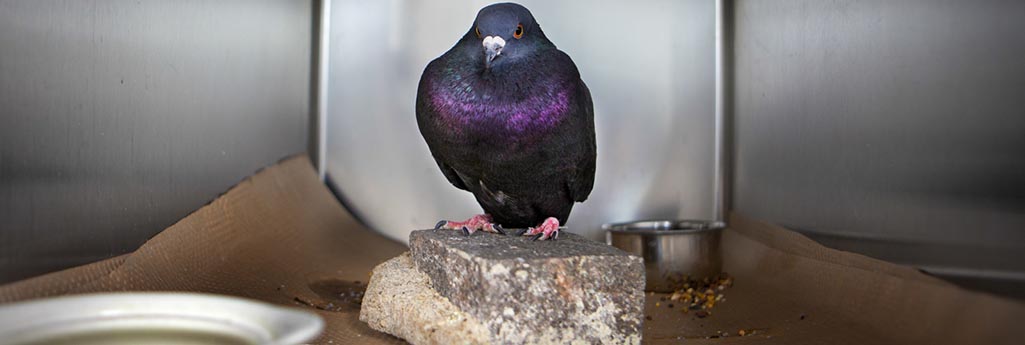
Photo by Mansura Khanam.
Pigeons are one of those birds considered to be among the lowest of animals; it is found at the bottom of the sociozoologic scale based on its use value to humans, and many people consider them vermin.

Bangladesh-born photographer Mansura Khanam has been photographing injured pigeons who are convalescing at the Wild Bird Fund, New York City’s rehabilitation center for wild birds.  These pigeons have suffered a whole host of problems thanks to their contact with humans, including Sharon, above, who suffered lead poisoning.

From CNN:

Through Khanam’s patient lens, the birds stare directly back at the human viewers. Eye to eye, it is harder to see them as “flying rats.”

They challenge us to acknowledge them.

These are monogamous birds whose mating rituals include aerial wing claps and special calls. These are birds that collaborate – males and females share nest-building and incubating time.

We are reminded that these adaptable creatures are in fact wild, and that we share a habitat.


Wednesday, July 17, 2013

Water and Watermelon for Dying Pigs

In the United States, the laws on transporting animals to slaughter are extremely lax.  The government suggests that transporters ideally keep trips under 8 hours, but at the very least give the animals a break from the truck once every 24 hours.  Animals are often deprived of food and water for hours or days because it will be wasted on a body that is about to be killed. Many drivers simply don't care or can't be bothered to let the animals out for a break. On the long transit to their death, these "food" animals are exposed to all elements, be it searing hot or so cold that the animals begin to freeze to each other and to the truck.  The journey is so brutal, an estimated 1 million pigs die in transit each year.

In this moment, these victims on route to the slaughterhouse are probably receiving the only bit of compassion they will ever know from humans, their last (maybe only) glimpse of sunlight, and certainly their only taste of watermelon. The ones trapped in the middle of the countless overheated, filthy bodies receive nothing. 

Photo by Anita Krajnc

As this image circulates across Facebook and advocacy networks, the response from viewers speaks to the power of emotion in narratives and photography.  Photographer Anita Krajnc writes:  "[ . . . ] if you haven't yet made the connection between the pleasure of your bacon and the misery of these animals' lives and death, may this image cause a change of heart."

Breaching the false divide between human and nonhuman/consumer and product, these women don't just ease the suffering of these pigs, they restore their personhood.  No longer faceless, nameless commodities, the pigs become individuals.  This image asks us to reconsider our relationship with so-called "food" animals.  Commodities or neighbors?  Friends or food?  Things or persons?  Rights-bearers or property?

Daisy enjoys some watermelon under happier circumstances.
Pigs Peace Sanctuary in Stanwood, WA.


Saturday, April 6, 2013

Art and Dead Animals

Lately I have been struck by artists who use dead animals in their work. The latest artist I've found is photographer Chris Jordan, who visited the Midway Atoll in the North Pacific Ocean, at the center of what is known as the Great Pacific Garbage Patch.

Jordan photographed dead albatross chicks who died thanks to the plastic garbage they had consumed. He wrote, "These images depict the actual stomach contents of baby birds in one of the world’s most remote marine sanctuaries, more than 2000 miles from the nearest continent."


Saturday, March 23, 2013

Landfill Dogs

Shannon Johnstone is a Louisiana photographer and animal advocate who uses her talents to bring attention to the tragedy of America's thrown away pets. She has documented companion animals before, during, and after their euthanasia in a project called Discarded Property, and her latest project, Landfill Dogs, involves taking dogs who have been at her local shelter for more than two weeks, and who will soon face euthanasia, to the landfill where their bodies will be buried, and photographing them where they play joyfully on what may be their last excursion outside in their lives. The great news is that thanks to her talent and courage, most of the dogs Johnstone has photographed have since found homes,  and have not ended up back at the landfill.

Wednesday, January 30, 2013

Faces

Photographer Andrew Bruce sent in this photo he took of his dog on his iphone. He noted:

As I raised my phone to look at my dog, the face recognition software (designed to recognise human faces and ensure that they are given an adequate exposure)  kicked in (the green rectangle signifies this).

I like the idea that my phone sees a face in my dog, just as I do.


Elderly Animals

Coping with the mortality of her parents, photographer Isa Leshko explores aging in the Nonhuman Animal world.  She specifically focuses on survivors of animal agriculture.  This is a rare glimpse into a life stage often robbed of those animals we raise for food.

 From the artist:

I am creating these photographs in order to take an unflinching look at aging and mortality. My maternal grandmother had dementia during her later years, and now my mom has it. I am scared of developing Alzheimer’s disease and I get nervous whenever I lose my keys or forget a person’s name. Photographing geriatric animals enables me to immerse myself in my fear of growing old. I have come to realize that these images are self-portraits. Or at the very least, they are manifestations of my fears and hopes about what I will be like when I am old.
I also want my images to inspire greater empathy toward animals, particularly farm animals. It is very rare for a farm animal to actually live its full natural lifespan given that most of these animals experience brutality and death early in their lives. By depicting the beauty and dignity of these creatures in their later years, I want to encourage people to question and challenge the way farm animals are currently treated.

Sunday, January 20, 2013

Pandas and the Internet

Pandas are one of the most popular of the charismatic animals. They rank very high on what sociologists Arluke and Sanders call the sociozoologic scale (along with dolphins, polar bears and other large, cute and cuddly animals), and therefore we are not just enamored of them, but we don't blink an eye when it comes to spending large amounts of resources to saving them, while letting other less charismatic animals perish by the billions.

Baby pandas are among the cutest of all of the charismatic animals, so each time a new panda is born at a zoo or a conservation facility in China, the Internet explodes with new photos and videos.

This little guy, Xiao Liwu, was born at the San Diego Zoo in 2012 and during a veterinary exam in December was so thrilled with his new green ball that he wouldn't stop hugging it throughout his exam. And reading that, 2 billion people collectively said "aawwwww."

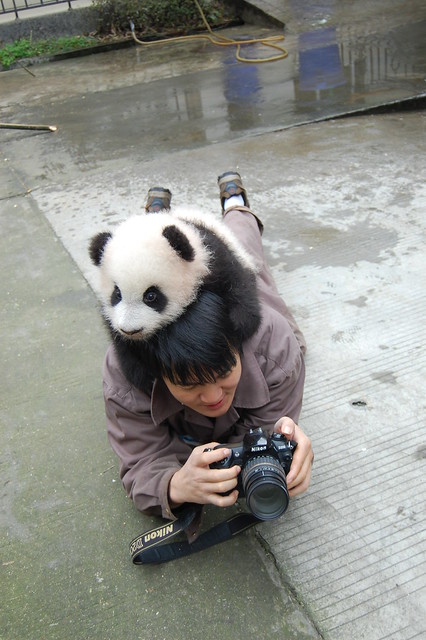
At China's Hetaoping Research and Conservation Center where pandas are bred and released to the wild, the caretakers go through an amazing amount of steps to make sure that the pandas who are to be released don't imprint on the humans, resulting in odd photos like this one.

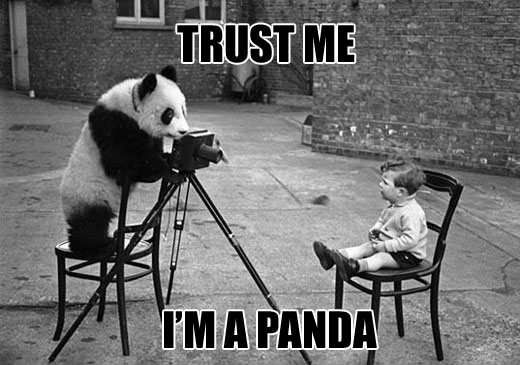
Recently, another odd photo has been circulating the Internet. This one is a vintage photo, and I can't seem to find anything about where it came from or what the context is. But it recently turned into a macro, based on the popular "I have no idea what I'm doing" meme.


What I find so interesting about this particular image is that we are just bananas about pandas right now; not too many other animals have their own webcams the way that pandas do, so that bored office workers can check in on them all day long. Captive pandas have cameras in their faces constantly, so the idea that this particular panda may have gotten hold of a camera and turned the tables on a human subject is amusing.


Or, as in the case of this last panda, he simply decided if you can't beat them, join them.

Saturday, January 19, 2013

Animals sitting like humans

One of the reasons we find animals on the Internet so fascinating are the ways that they so often seem so like us. Recently, a popular image theme is "animals who sit like humans." It's difficult to see these pictures and not imagine these dogs, cats, frogs, and other animals as small (or large), extra cute people.