Does the public care about saving endangered and threatened species?
Yes and no.
Certainly, we say that we do, but our actions certainly tell a different story, as most of us go about our lives as if anywhere from 200 (on the very low end) and 100,000 species are not becoming extinct every single year, according to estimates from the World Wildlife Fund.
Unlike the previous five major extinction events in the world's history, what we are living through, according to most scientists, is caused primarily by humans. And yet most people do nothing to slow down the climate change which is largely responsible for many of these extinctions, for example, nor do they think about where the exotic wood that their furniture came from and what animals may have once lived in the rainforest from which it came, nor do they worry about the seafood that they eat and whether those fishes are being fished to the point of extinction, for example.
What would make us care, and more importantly, do something?
Studies (see for example Gunnthorsdottir
2001) show that people care more about animals that are attractive than those that are unattractive. So this article from January 2013 on the threatened nature of four arctic species highlights how "adorable" those animals are. As ridiculous as the headline seems, most readers really do care more if the animals are adorable, and thus may take some action to save them.
Artist Justin Steinburg took a similar approach. In a series of illustrations that he did for the World Wildlife Fund, he represented a number of endangered animals as sugar skulls that are used on the Dia de los Muertos--the Mexican Day of the Dead. This is the day when people through out much of Latin America pay respect to their dead ancestors. According to Steinburg's website, "we must learn to celebrate the beauty of these endangered animals while they are still alive."
Steinburg's illustrations, in borrowing the iconography of the Day of the Dead, highlights the fact that these animals are themselves on the brink of death, spurring the viewer to take action to help save them.
But it's worth noting that he also highlights their beauty, and that the animals he picks--a gorilla, a panda, and a tiger--are all among the most charismatic of the large animals, and thus, already those that we would feel most drawn to, and most likely to want to save.
If pandas, arguably one of the "cutest" of all of the animals (if you don't believe me, check this out), are on the brink of extinction, then what hope is there for an "ugly" animal like the Rabb’s fringe-limbed tree frog?
In fact, the fastest growing group of endangered species, with 1,895 out of 6,285 species in
danger of extinction according to the International Union for Conservation of Nature, are amphibians, one of the least-liked of all animals.
That spells bad news for the tree frog.
Showing posts with label Charismatic. Show all posts
Saturday, November 30, 2013
Depicting Endangered Species
Labels:
Charismatic,
climate change,
extinction,
pandas
Sunday, January 20, 2013
Pandas and the Internet
Pandas are one of the most popular of the charismatic animals. They rank very high on what sociologists Arluke and Sanders call the sociozoologic scale (along with dolphins, polar bears and other large, cute and cuddly animals), and therefore we are not just enamored of them, but we don't blink an eye when it comes to spending large amounts of resources to saving them, while letting other less charismatic animals perish by the billions.
Baby pandas are among the cutest of all of the charismatic animals, so each time a new panda is born at a zoo or a conservation facility in China, the Internet explodes with new photos and videos.
This little guy, Xiao Liwu, was born at the San Diego Zoo in 2012 and during a veterinary exam in December was so thrilled with his new green ball that he wouldn't stop hugging it throughout his exam. And reading that, 2 billion people collectively said "aawwwww."
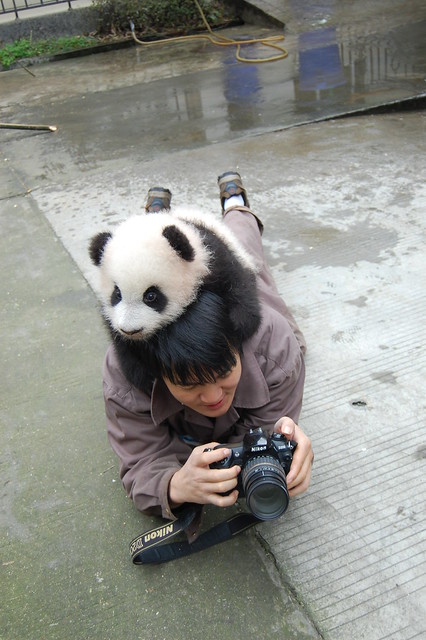
At China's Hetaoping Research and Conservation Center where pandas are bred and released to the wild, the caretakers go through an amazing amount of steps to make sure that the pandas who are to be released don't imprint on the humans, resulting in odd photos like this one.
Recently, another odd photo has been circulating the Internet. This one is a vintage photo, and I can't seem to find anything about where it came from or what the context is. But it recently turned into a macro, based on the popular "I have no idea what I'm doing" meme.
What I find so interesting about this particular image is that we are just bananas about pandas right now; not too many other animals have their own webcams the way that pandas do, so that bored office workers can check in on them all day long. Captive pandas have cameras in their faces constantly, so the idea that this particular panda may have gotten hold of a camera and turned the tables on a human subject is amusing.

Or, as in the case of this last panda, he simply decided if you can't beat them, join them.
Baby pandas are among the cutest of all of the charismatic animals, so each time a new panda is born at a zoo or a conservation facility in China, the Internet explodes with new photos and videos.
This little guy, Xiao Liwu, was born at the San Diego Zoo in 2012 and during a veterinary exam in December was so thrilled with his new green ball that he wouldn't stop hugging it throughout his exam. And reading that, 2 billion people collectively said "aawwwww."
At China's Hetaoping Research and Conservation Center where pandas are bred and released to the wild, the caretakers go through an amazing amount of steps to make sure that the pandas who are to be released don't imprint on the humans, resulting in odd photos like this one.
Recently, another odd photo has been circulating the Internet. This one is a vintage photo, and I can't seem to find anything about where it came from or what the context is. But it recently turned into a macro, based on the popular "I have no idea what I'm doing" meme.
Or, as in the case of this last panda, he simply decided if you can't beat them, join them.
Labels:
Charismatic,
internet,
pandas,
photography,
sociozoologic scale
Saturday, January 19, 2013
Are just the adorable animals worth saving?
Marion Copeland posted a link on the H-NILAS listserv to an article about climate change. The article noted the four "adorable" species impacted by climate change, which begs the question: are only adorable animals worth saving?
Labels:
Charismatic,
climate change,
sociozoologic scale
Subscribe to:
Posts (Atom)